
— News Center
US Starts HR Coil Dumping Review, Pressuring Profile Exports

On July 2, 2026, the U.S. Department of Commerce formally opened a second expedited sunset review of the antidumping duty order on hot-rolled steel coil from China, covering products under HS codes 7208.51-7208.90. The immediate issue for the market is not only the review itself, but the possibility that current antidumping duty rates of 12.3% to 48.6% could remain in place through 2031. That makes this development relevant well beyond coil trade, especially for exporters, importers, distributors, and profile manufacturers whose cold-formed sections and structural steel products rely on HR coil as an upstream input.
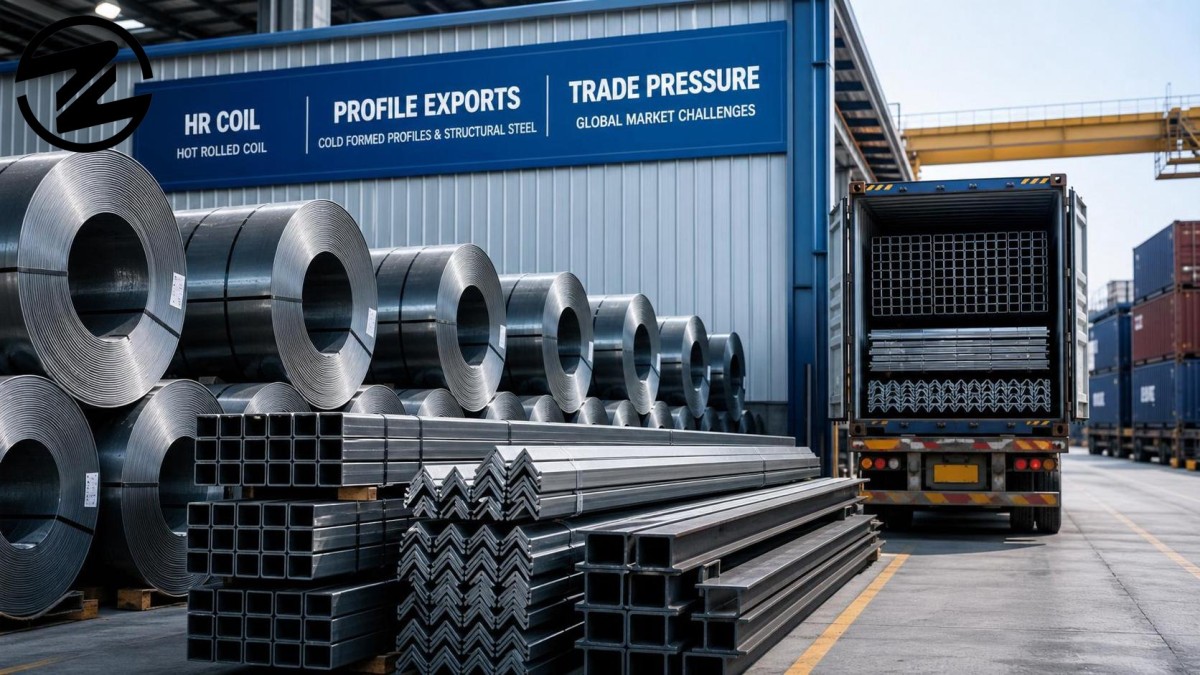
What Has Been Formally Put Into Review
The confirmed facts are limited but commercially significant. The review was officially announced on July 2, 2026 by the U.S. Department of Commerce. It concerns the second expedited sunset review of the antidumping duty order on Chinese hot-rolled steel coil, with the scope identified in the input as HS codes 7208.51-7208.90. The outcome will determine whether the existing antidumping duty rates, currently listed at 12.3% to 48.6%, will continue through 2031.
The summary further confirms that the review may affect downstream export categories that use HR coil as feedstock, including cold-formed profiles and structural steel sections. It also confirms that profile manufacturers, distributors, and importers serving the U.S. market need to reassess compliance routes, cost structures, and delivery timing.
Why the Pressure Extends Beyond Coil Trade
Downstream exporters face a renewed input-risk calculation
From an industry perspective, manufacturers exporting profile products to the United States may be affected because the review targets a core upstream material rather than a narrow finished item. Where HR coil is the base input, any continued duty exposure can influence product pricing, margin planning, and shipment timing for downstream goods. What deserves closer attention is whether companies have clear internal mapping between finished export items and the HR coil input categories tied to this review.
Importers and distributors may need tighter document control
For importers and distribution channels, the issue is likely to show up in transactional compliance rather than only in tariff cost. Review-related developments can change how firms assess landed cost assumptions, sourcing arrangements, and contract exposure. Analysis shows that importers and distributors should pay close attention to product classification, supporting trade documents, supplier declarations, and any commercial paperwork that links finished products to upstream material sourcing.
Procurement and supply-chain teams may see planning friction
For procurement and supply-chain service providers, the likely impact is operational. If the market expects duty exposure to continue, companies may revisit supplier mixes, purchasing cycles, and buffer-stock decisions. In practical terms, this can affect quotation validity, order confirmation, and delivery scheduling for profile products tied to U.S.-bound business.
What Companies Should Track Now
Review whether product and input mapping is still robust
Analysis shows that exporters and manufacturers should revisit how HR coil inputs are linked to downstream products in internal records. The key point is not to assume that downstream goods are commercially insulated simply because the review names upstream coil products. Firms with U.S.-facing business should be able to trace affected input categories through procurement, production, and export documentation.
Recheck cost models against duty-continuation risk
The current review directly affects whether existing duty rates remain in force through 2031. Observably, that means cost models built on temporary or uncertain assumptions may need to be retested. Companies should pay attention to pricing terms, margin assumptions, and delivery commitments where orders depend on HR coil-based inputs.
Prepare for closer scrutiny of documents and technical files
Where downstream profile products are exported, supporting documents may become more important in demonstrating product scope, sourcing logic, and transaction consistency. What deserves closer attention is whether commercial documents, technical descriptions, test records, and bidding materials describe products in a way that aligns with actual input use and trade declarations.
Watch for changes in execution language rather than assuming a final outcome
The available input does not provide detailed implementation language beyond the formal start of the expedited sunset review and its possible effect on duty continuation. It is therefore more appropriate to monitor later official wording, customer requirements, procurement terms, and market responses instead of treating the current development as a fully settled execution result.
How This Development Should Be Read at This Stage
Analysis shows that this is best understood as a live trade-rule signal with immediate commercial relevance, rather than as a completed market outcome. The formal start of the review matters because it reopens attention to an existing duty framework and extends uncertainty across the supply chain for products built from HR coil. For the industry, the practical question is less about headline policy language and more about how trade participants adjust compliance review, cost planning, and delivery commitments while the review process remains active.
Observably, this is also a reminder that upstream trade measures can shape downstream export decisions even when the downstream items are not themselves described as the primary subject of the review notice. That is why manufacturers, importers, and distributors are likely to keep watching not only official statements but also how procurement documents, customer specifications, and transaction controls evolve.
Why Ongoing Monitoring Matters More Than Immediate Conclusions
At this point, the event carries clear significance because it places the continuation of existing antidumping duty rates back into active review and directly affects planning for HR coil-linked export business. A measured reading is more appropriate than a definitive one: the rule environment has not yet produced a new final result, but the review itself is already an operational factor for cost, compliance, and lead-time management. For affected companies, this is better understood as an execution-relevant policy development that requires continued monitoring rather than as a closed conclusion.
Basis of This Article and What Still Needs Verification
This article is based on the user-provided news title, event date, and event summary. For events of this type, relevant source categories typically include official announcements, releases from regulatory authorities, customs or trade administration information, industry association updates, standard-setting documents, and reporting by authoritative media. A specific official source link was not provided in the input, so the underlying notice and any later procedural details still need to be verified on an ongoing basis.
Further observation is still needed on later official wording, implementation interpretation, compliance expectations, bidding or procurement document changes, market feedback, and how affected companies adjust execution in practice.
By clicking 'Allow All', you agree to the storage of cookies on your device to enhance site navigation, analyze site usage and assist with our marketing efforts.
Leave a message and we'll get back to you soon.